> ## Documentation Index
> Fetch the complete documentation index at: https://wtd2026.mintlify.site/llms.txt
> Use this file to discover all available pages before exploring further.
# Reading: how people use AI to consume docs
> Data on how people use agents to read documentation on their behalf.
**How people use agents to consume documentation.**
Mintlify's embedded AI assistant lets users ask questions and get answers directly from a site's documentation. This is the layer between human users and documentation pages. Data from April 21, 2026.
## Scale
| Metric | Value |
| -------------------------- | ----- |
| Total requests | 95k |
| Unique sessions | 29k |
| Unique documentation sites | 1.2k |
Failed sessions and abusive sessions are not included.
## Message types
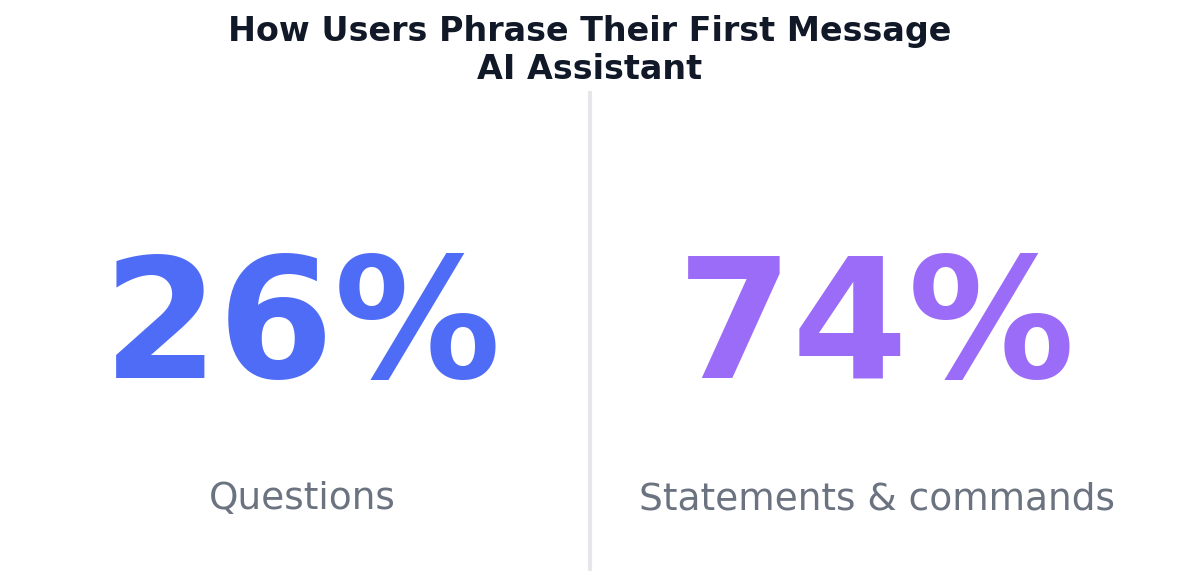
Most agent-mediated documentation interactions are not questions. Statements and commands dominate.
| Message type | Share |
| ------------ | ----- |
| Statement | 62% |
| Question | 30% |
| Troubleshoot | 5% |
| Command | 3% |
 ## First message intent
| Intent | Share |
| ---------------- | ----- |
| How to | 30% |
| Topic lookup | 16% |
| Capability check | 14% |
| Conceptual | 12% |
| Troubleshoot | 10% |
| Other | 15% |
| Show example | 1% |
| Why | 1% |
## Message length
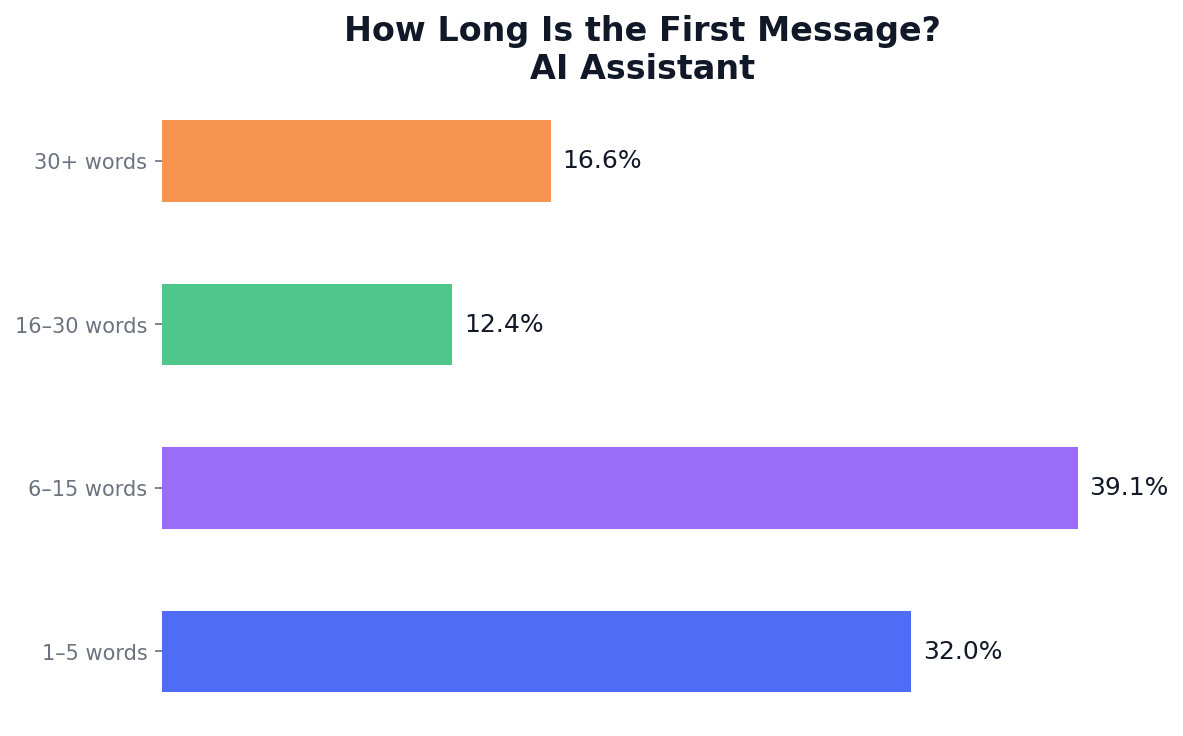
Most users are terse.
| Metric | Value |
| ----------------------------- | ---------- |
| First messages under 15 words | 71% |
| First messages 1-5 words | 32% |
| Median user message | 9 words |
| Average user message | 46.9 words |
| Median assistant response | 10 words |
| Average assistant response | 29.6 words |
## First message intent
| Intent | Share |
| ---------------- | ----- |
| How to | 30% |
| Topic lookup | 16% |
| Capability check | 14% |
| Conceptual | 12% |
| Troubleshoot | 10% |
| Other | 15% |
| Show example | 1% |
| Why | 1% |
## Message length
Most users are terse.
| Metric | Value |
| ----------------------------- | ---------- |
| First messages under 15 words | 71% |
| First messages 1-5 words | 32% |
| Median user message | 9 words |
| Average user message | 46.9 words |
| Median assistant response | 10 words |
| Average assistant response | 29.6 words |
 ## Verbosity by turn
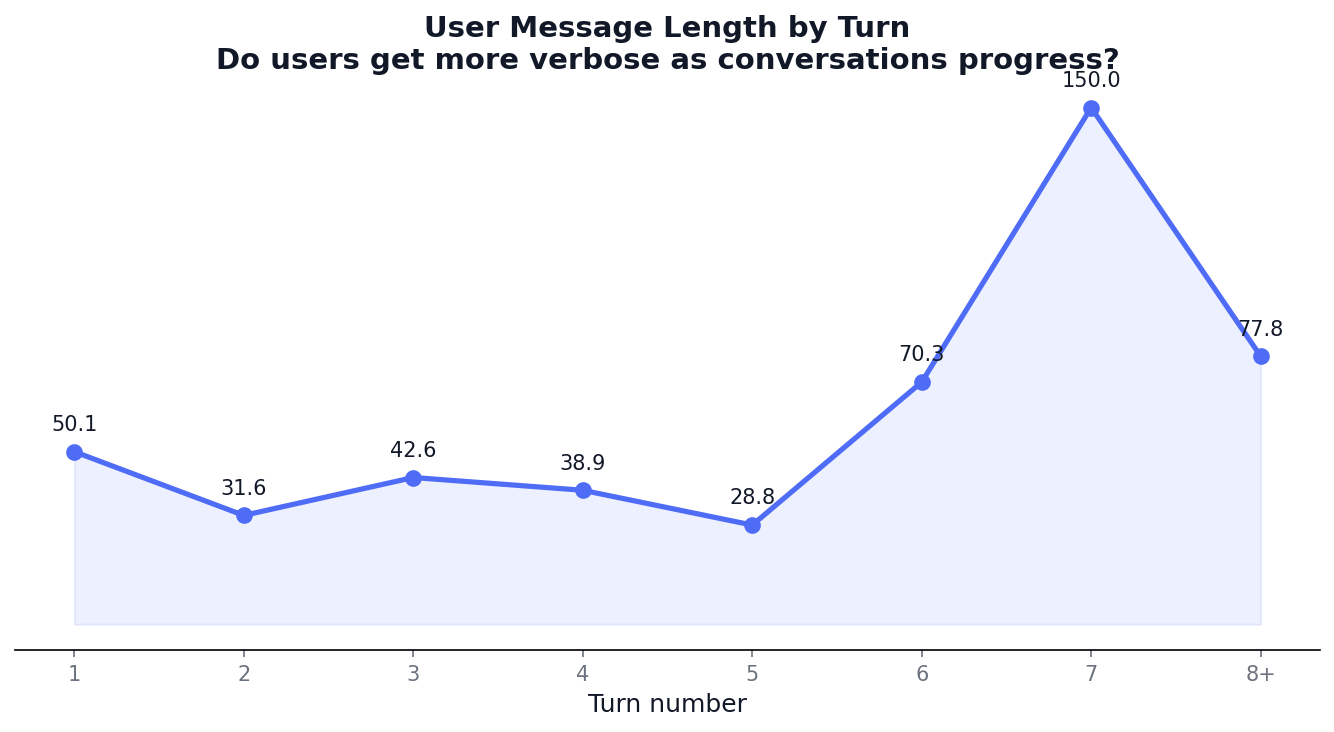
Message length isn't stable across a conversation.
| Turn | Avg user message length |
| ---- | --------------------------------- |
| 1 | \~50 words |
| 2 | \~32 words |
| 3 | \~43 words |
| 6-7 | 70-150 words (frustration signal) |
The spike at turns 6 and 7 is a key insight: users who persist through multiple failures eventually dump everything they know into one message. Intervening at turn 5 is a design opportunity.
## Verbosity by turn
Message length isn't stable across a conversation.
| Turn | Avg user message length |
| ---- | --------------------------------- |
| 1 | \~50 words |
| 2 | \~32 words |
| 3 | \~43 words |
| 6-7 | 70-150 words (frustration signal) |
The spike at turns 6 and 7 is a key insight: users who persist through multiple failures eventually dump everything they know into one message. Intervening at turn 5 is a design opportunity.
 ## Conversation length
### Conversation length
| Turns per session | Sessions |
| ----------------- | -------- |
| 1 | 14,443 |
| 2 | 5,898 |
| 3 | 2,868 |
| 4 | 1,593 |
| 5 | 999 |
| 6 | 669 |
| 7 | 449 |
| 8 | 388 |
| 9-14 | 730 |
| 15+ | 391 |
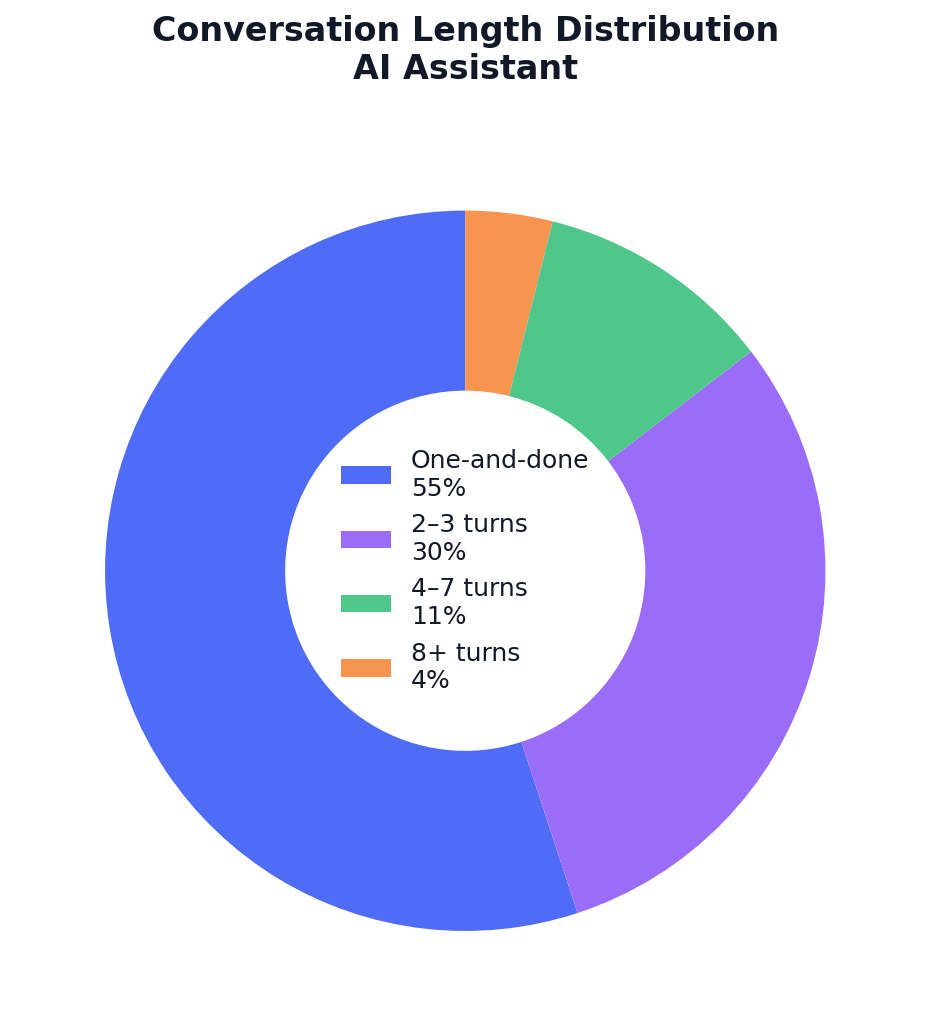
Half of sessions end after a single message.
## Conversation length
### Conversation length
| Turns per session | Sessions |
| ----------------- | -------- |
| 1 | 14,443 |
| 2 | 5,898 |
| 3 | 2,868 |
| 4 | 1,593 |
| 5 | 999 |
| 6 | 669 |
| 7 | 449 |
| 8 | 388 |
| 9-14 | 730 |
| 15+ | 391 |
Half of sessions end after a single message.
 ## Frustration rate
The frustration rate is the share of sessions where the last user message was negatively-toned. It rises with conversation length.
| Turn | Frustration rate |
| ---- | ---------------- |
| 1 | 5% |
| 2 | 6% |
| 3 | 7% |
| 4 | 8% |
| 5-7 | 9% |
| 8 | 19% |
| 9-11 | 11% |
| 12 | 15% |
| 13 | 11% |
| 14 | 10% |
| 15+ | 14% |
The spike at turn 8 (19%) is a key signal. Intervening at turn 5 or 6—before the spike—is a design opportunity.
## Sentiment arc in multi-turn sessions
Among 3,712 sessions with 3 or more turns, four trajectory shapes emerge:
| Shape | Sessions | What it means |
| ------- | -------- | -------------------------------------------------------- |
| Flat | 1,524 | Task-oriented, neutral throughout — probably successful |
| Rising | 1,086 | Starts frustrated, improves — recovery |
| Falling | 1,023 | Starts okay, ends frustrated — failure pattern |
| U-shape | 79 | Dips in the middle, recovers — successful after struggle |
1,023 falling-arc sessions out of 3,712 multi-turn sessions (27.5%). More than one in four multi-turn conversations ends worse than it started.
## Sentiment overall
From a sample of \~3,300 records (keyword-based, directional):
| Sentiment | Share |
| --------- | ----- |
| Neutral | 77.9% |
| Positive | 15.4% |
| Negative | 6.7% |
## Response time
| Metric | Value |
| --------------------------- | ----------- |
| Average response time | 3.7 seconds |
| Median response time | 2.9 seconds |
| Average time to first token | 1.8 seconds |
6 errors out of 94,668 requests.
## Benchmark
**One-and-done: 55%**
55% of sessions end after a single message.
## How to measure
What you have access to depends on which agent platform you use. At minimum, look for:
* Session length distribution (how many one-and-dones?)
* Repeat usage (do users come back?)
* Explicit feedback if available (thumbs up/down)
* Turn-level sentiment if you can get it
## Frustration rate
The frustration rate is the share of sessions where the last user message was negatively-toned. It rises with conversation length.
| Turn | Frustration rate |
| ---- | ---------------- |
| 1 | 5% |
| 2 | 6% |
| 3 | 7% |
| 4 | 8% |
| 5-7 | 9% |
| 8 | 19% |
| 9-11 | 11% |
| 12 | 15% |
| 13 | 11% |
| 14 | 10% |
| 15+ | 14% |
The spike at turn 8 (19%) is a key signal. Intervening at turn 5 or 6—before the spike—is a design opportunity.
## Sentiment arc in multi-turn sessions
Among 3,712 sessions with 3 or more turns, four trajectory shapes emerge:
| Shape | Sessions | What it means |
| ------- | -------- | -------------------------------------------------------- |
| Flat | 1,524 | Task-oriented, neutral throughout — probably successful |
| Rising | 1,086 | Starts frustrated, improves — recovery |
| Falling | 1,023 | Starts okay, ends frustrated — failure pattern |
| U-shape | 79 | Dips in the middle, recovers — successful after struggle |
1,023 falling-arc sessions out of 3,712 multi-turn sessions (27.5%). More than one in four multi-turn conversations ends worse than it started.
## Sentiment overall
From a sample of \~3,300 records (keyword-based, directional):
| Sentiment | Share |
| --------- | ----- |
| Neutral | 77.9% |
| Positive | 15.4% |
| Negative | 6.7% |
## Response time
| Metric | Value |
| --------------------------- | ----------- |
| Average response time | 3.7 seconds |
| Median response time | 2.9 seconds |
| Average time to first token | 1.8 seconds |
6 errors out of 94,668 requests.
## Benchmark
**One-and-done: 55%**
55% of sessions end after a single message.
## How to measure
What you have access to depends on which agent platform you use. At minimum, look for:
* Session length distribution (how many one-and-dones?)
* Repeat usage (do users come back?)
* Explicit feedback if available (thumbs up/down)
* Turn-level sentiment if you can get it